Quick Information

RECOMMENDED DURATION

4 hours

VISITORS PER YEAR

3210000

NUMBER OF ENTRANCES

2

Plan your visit

Did you know?

The Met has its own resident florist: The Great Hall boasts of towering magnificent floral displays. This floral arrangement is artfully curated by Remco van Vliet since 2003 and endowed by Reader’s Digest co-founder Lila Acheson Wallace.

See ancient treasures in the 21st century: An extensive collection of ancient Egyptian artifacts can be found at The Metropolitan Museum of Art, including the Temple of Dendur, gifted by Egypt to the United States in 1965.

The Met is home to more than 5000 musical instruments : Among the Met’s eclectic holdings are over 5,000 musical instruments from around the world, showcasing the cultural significance of music throughout history.

Book The Metropolitan of Art tickets

Museum of Modern Art (MoMA) Tickets

Flexible duration
Audio guide

Metropolitan Museum of Art Pre-Orientation Tour with Skip-the-Line Access

Free cancellation
Book now, pay later
2 hr.
Audio guide

Metropolitan Museum of Art Highlights Guided Tour with Skip-the-Line Access

Free cancellation
Book now, pay later
Flexible duration

Combo (Save 5%): Museum of Modern Art + 90-Min NYC Downtown Sightseeing Cruise

Audio guide
Guided tour

Collection highlights

The Metropolitan Museum of Art is home to over 5,000 years of art from around the world for everyone to experience and enjoy.

The American Wing

Ever since its establishment in 1870, the Met has acquired important examples of American art. Today, the museum’s American Wing collection comprises around 20,000 works of art including painting, sculpture, works on paper, and decorative arts, as well as historical interiors and architectural fragments.

Greek and Roman Art

The Met’s collection of Greek and Roman art comprises more than 30,000 works representing geographic regions of Greece and Italy, but not as delimited by modern political frontiers. It includes the art of many cultures and is among the most comprehensive in North America.

The Costume Institute

The Costume Institute boasts of a collection exceeding 33,000 objects, showcasing stylish attire and accessories spanning seven centuries. This diverse collection encompasses fashionable dress and accessories for men, women, and children, offering a rich tapestry of styles from the fifteenth century to the present day.
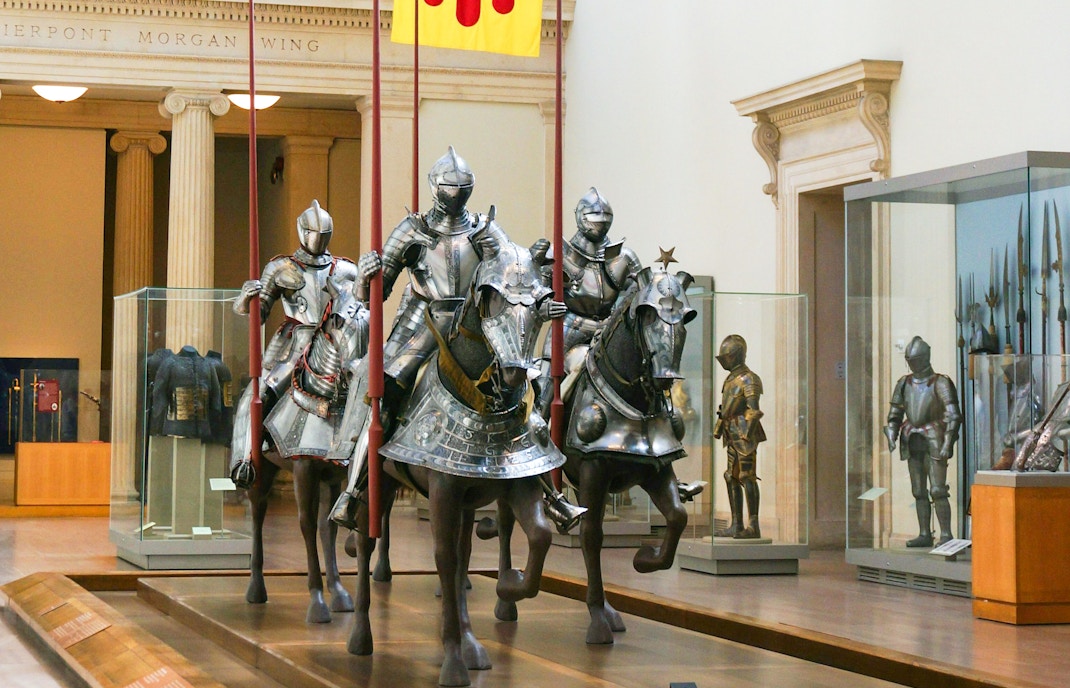
Arms and Armor

Arms and armor have been a vital part of virtually all cultures for thousands of years. The aim of this collection is to preserve, research, publish, and exhibit distinguished examples representing the art of the armorer, swordsmith, and gunmaker.

European Sculpture and Decorative Arts

The 50,000 objects in the collection of European sculpture and decorative arts reflect the development of a number of art forms in Western European countries from the early fifteenth through the early twentieth century.

Must see artworks of The Metropolitan Museum of Art

Wheat Field with Cypresses

Artist: Vincent van Gogh

Wheat Field with Cypresses affords an unprecedented perspective on a motif virtually synonymous with the Dutch artist’s fiercely original power of expression.

The Thinker

Sculptor: Auguste Rodin

Cast by: Alexis Rudier

The Thinker is one of French artist Auguste Rodin’s most well-known works.

The Death of Socrates

Artist: Jacques Louis David

In this landmark of neoclassical painting from just before the French Revolution, David took up a classical story of resisting unjust authority in a sparse, friezelike composition.

Head of a Queen Mother (Iyoba)

Culture: Edo peoples

In the Benin kingdom, the heads of queen mothers are distinguished from those of kings by the forward-pointing peaks of their coral-beaded crowns.

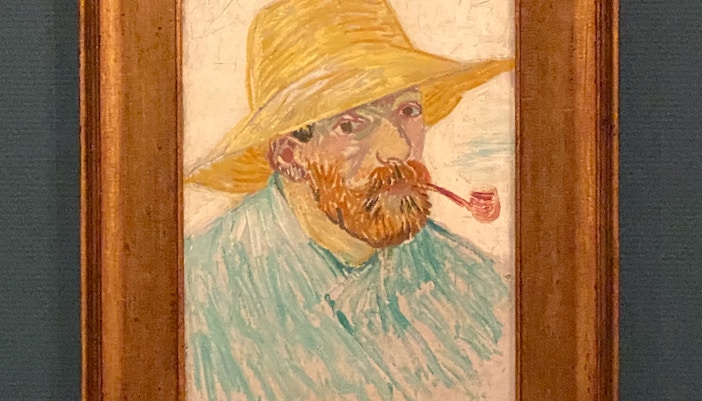
Self-Portrait with a Straw Hat

Artist: Vincent van Gogh

This picture shows Vincent van Gogh’s awareness of Neo-Impressionist technique and color theory.

Washington Crossing the Delaware

Artist: Emanuel Leutze

Emanuel Leutze's depiction of Washington's attack on the Hessians at Trenton on December 25, 1776.

Self-Portrait

Artist: Rembrandt

Roughly forty self-portraits by Rembrandt survive today.

The Gulf Stream

Artist: Winslow Homer

This painting is the culminating expression of various deeply personal and universal themes that Homer explored across his career.

Madonna and Child Enthroned with Saints

Artist: Raphael

Raphael painted this altarpiece around 1504/5 for the Franciscan convent of Sant’Antonio in Perugia.

The Musicians

Artist: Caravaggio

Caravaggio’s The Musicians of 1595–96 is a depiction of musicians rehearsing and encapsulates the moody experimental character of the cardinal’s musical patronage.

Study of a Young Woman

Artist: Johannes Vermeer

This painting was painted around the same time as the Girl with a Pearl Earring and has a near-identical size.

The Vision of Saint John

Artist: El Greco

This work is a fragment from a large altarpiece made for the church of the hospital of Saint John the Baptist in Toledo.

true " />

Brief history of The Metropolitan Museum of Art

1866: The Metropolitan Museum of Art’s earliest roots trace back to 1866 in Paris, France, when a group of Americans envisioned creating a "national institution and gallery of art" to bring art and education to the American people.

13 April 1870: The Metropolitan Museum of Art was founded in 1870 under the leadership of lawyer John Jay through the Union League Club with the help of civic leaders, businessmen, artists, art collectors, and philanthropists.

30 March 1880: After a brief move to the Douglas Mansion at 128 West 14th Street, the Museum opened to the public at its current site on Fifth Avenue and 82nd Street.

1902: The Museum's Beaux-Arts Fifth Avenue facade and Great Hall, designed by the architect and founding Museum Trustee Richard Morris Hunt, opened to the public in December this year.

1991: A comprehensive architectural plan for the Museum by the architects Kevin Roche John Dinkeloo and Associates was completed.

Who founded The Metropolitan Museum of Art?

In 1866, a visionary group of Americans in Paris, led by lawyer John Jay, conceived the idea of creating a "national institution and gallery of art" to bring the richness of art and education to the American people.

Upon Jay's return to the United States from France, he energetically spearheaded the project. The Union League Club in New York, under Jay's presidency, rallied support from civic leaders, businessmen, artists, art collectors, and philanthropists.

On 13 April 1870, The Metropolitan Museum of Art was officially incorporated and opened its doors to the public in the Dodworth Building at 681 Fifth Avenue.

Architecture of The Met

The Metropolitan Museum of Art

Architects Calvert Vaux and Jacob Wrey Mould designed the initial Ruskinian Gothic structure. The building has since expanded greatly. Various additions completely surround the original structure. The west facade of the original structure is still visible in the Robert Lehman Wing.

The Met's main building facing Fifth Avenue was designed by Richard Morris Hunt and completed in 1902. Architect and founding Museum Trustee, Hunt also designed the museum’s Great Hall. The American section was added in 1924. It now houses the world's most comprehensive collection of American paintings, sculpture, and decorative arts.

In 1991 an architectural plan was made by architects Kevin Roche John Dinkeloo and Associates to make additions to the structure such as the Robert Lehman Wing, the American Wing, Michael C. Rockefeller Wing, among others. For the remainder of the 20th-century, Kevin Roche John Dinkeloo and Associates completed these various additions.

The Met's New American Wing Galleries for Paintings, Sculpture, and Decorative Arts reopened on 16 January 2012.

The Met Cloisters

The Metropolitan Museum of Art

Apart from the art museum on Fifth Avenue, another branch of The Metropolitan Museum of Art, the Met Cloisters opened to the public on 10 May 1938. Located in Fort Tryon Park in northern Manhattan, The Met Cloisters is devoted to the art and architecture of medieval Europe. Overlooking the Hudson River, the modern museum building designed by Charles Collens is a combination of ecclesiastical and secular spaces arranged in chronological order.

Much of the sculpture at The Met Cloisters was acquired by prominent American sculptor George Grey Barnard. Approximately 2,000 works of art from medieval Europe including exquisite illuminated manuscripts, stained glass, metalwork, enamels, ivories, and tapestries are exhibited here.

Among the collection at The Met Cloisters are an early 15th-century French illuminated book of hours, The Belles Heures of Jean de France, Duc de Berry; a richly carved, 12th-century ivory cross attributed by some to the English abbey of Bury Saint Edmunds; and more.

Frequently asked questions about The Metropolitan Museum of Art, New York

The Metropolitan Museum of Art, often referred to as The Met, is an art museum located in New York. The Museum lives in two iconic sites — The Met Fifth Avenue and The Met Cloisters.